
14K vs. 18K gold — what is the real difference?
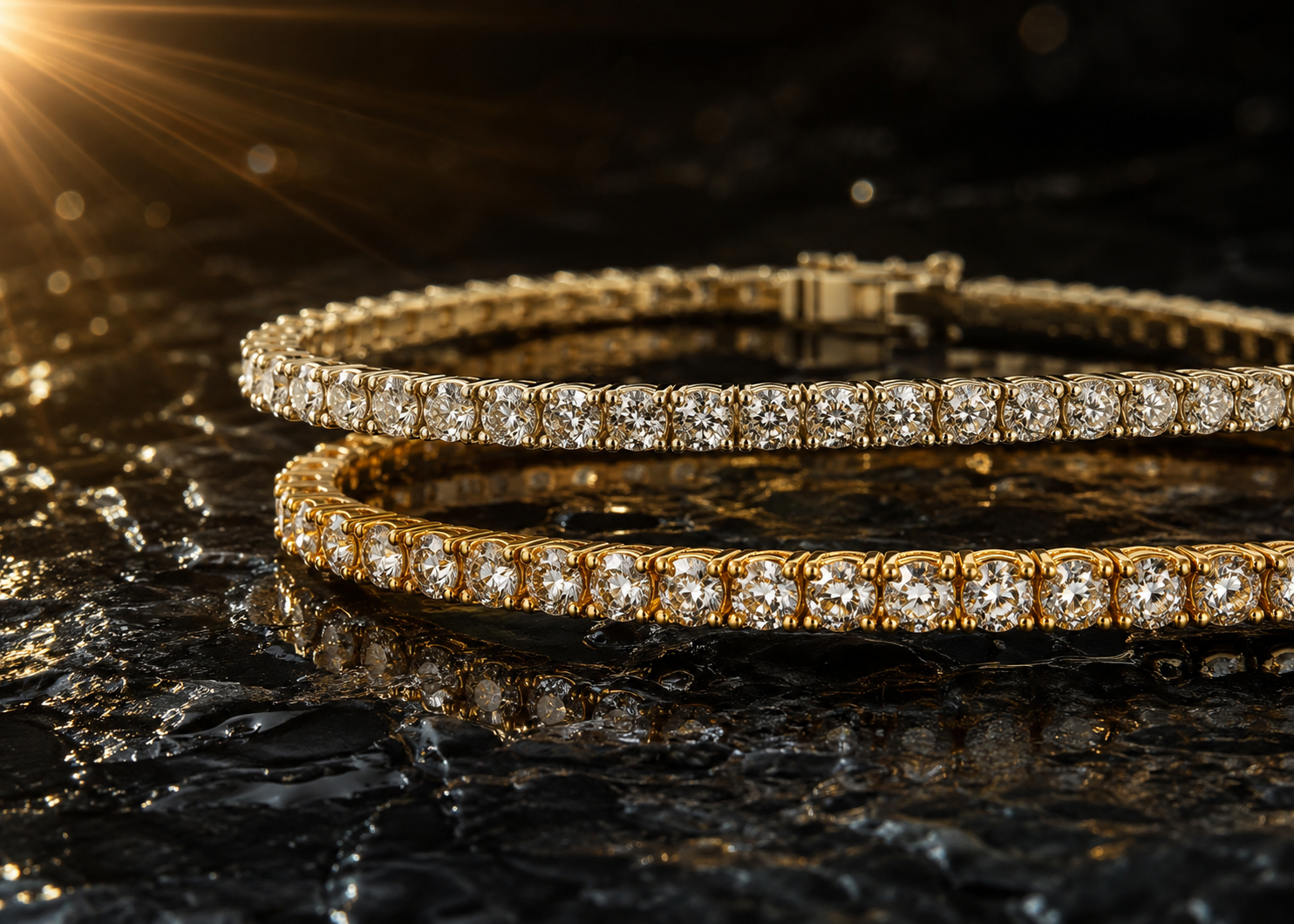
When choosing a tennis bracelet or other piece of jewellery, you quickly come across the question: should it be 14 karat or 18 karat gold? At first glance the two look the same, but the difference matters for appearance, durability and price. Here we explain what the difference really is — and why it matters for your choice.
Karat is about purity, not size
It is easy to confuse gold karats with diamond carats, but the two have nothing to do with each other. Diamond carat (ct) indicates a diamond's weight. Gold karat, on the other hand, indicates how pure the gold is — that is, how much of the piece is actually gold and how much is other metals (the alloy). Pure 24 karat gold is too soft for jewellery that must withstand daily wear, so it is always mixed with other metals such as silver, copper or palladium to make it stronger.
14 karat gold: 58.3% pure gold
14 karat gold consists of 14/24 parts pure gold, equivalent to 58.3%. The remaining 41.7% is alloy metals. This makes 14 karat gold harder and more resistant to scratches and knocks than higher-karat gold — a quality that has historically made it popular for jewellery exposed to a lot of movement and contact, such as watches and bracelets.
18 karat gold: 75% pure gold
18 karat gold consists of 18/24 parts pure gold, equivalent to 75%. The higher gold content gives a deeper, warmer and more vibrant colour — especially noticeable in yellow gold, where 18 karat has a richer tone than 14 karat. The lower proportion of alloy metals also makes 18 karat gold better suited to sensitive skin, as the risk of reactions to alloy metals (e.g. nickel) is reduced. On the other hand, 18 karat gold is slightly softer than 14 karat and can in theory be marginally more prone to scratches under very hard wear.
What does it mean for the price?
The gold price is determined by the amount of pure gold in the piece. Since 18 karat gold contains significantly more pure gold than 14 karat (75% versus 58.3%), 18 karat gold is in itself more expensive to produce — typically 20–30% more in pure material value. That is why most jewellery retailers either sell 14 karat as standard or add a considerable surcharge for 18 karat versions.
How we do it at Manich
Because we design our tennis bracelets ourselves and have them made directly by our regular production partners with no middlemen, we can offer 18 karat gold at a price normally reserved for 14 karat jewellery at other retailers. This means you do not have to choose between the richer colour and skin-friendliness of 18 karat gold and a sensible price — we have removed that compromise.
| 14 karat gold | 18 karat gold | |
|---|---|---|
| Gold content | 58.3% | 75% |
| Colour | Lighter, more subdued tone | Deeper, warmer and more vibrant tone |
| Durability | Harder, more scratch-resistant | Slightly softer |
| Skin-friendliness | Good, but more alloy | Better for sensitive skin |
| Price | Lower material cost | Higher material cost — but the same price at Manich |
Conclusion: which should you choose?
There is no single right answer — it depends on your priorities. Choose 14 karat gold and you get a piece that is slightly more resistant to everyday scratches. Choose 18 karat gold and you get a richer colour and better skin-friendliness. At Manich you do not have to choose on price alone, because our direct production means 18 karat gold costs the same as 14 karat does at most other places.