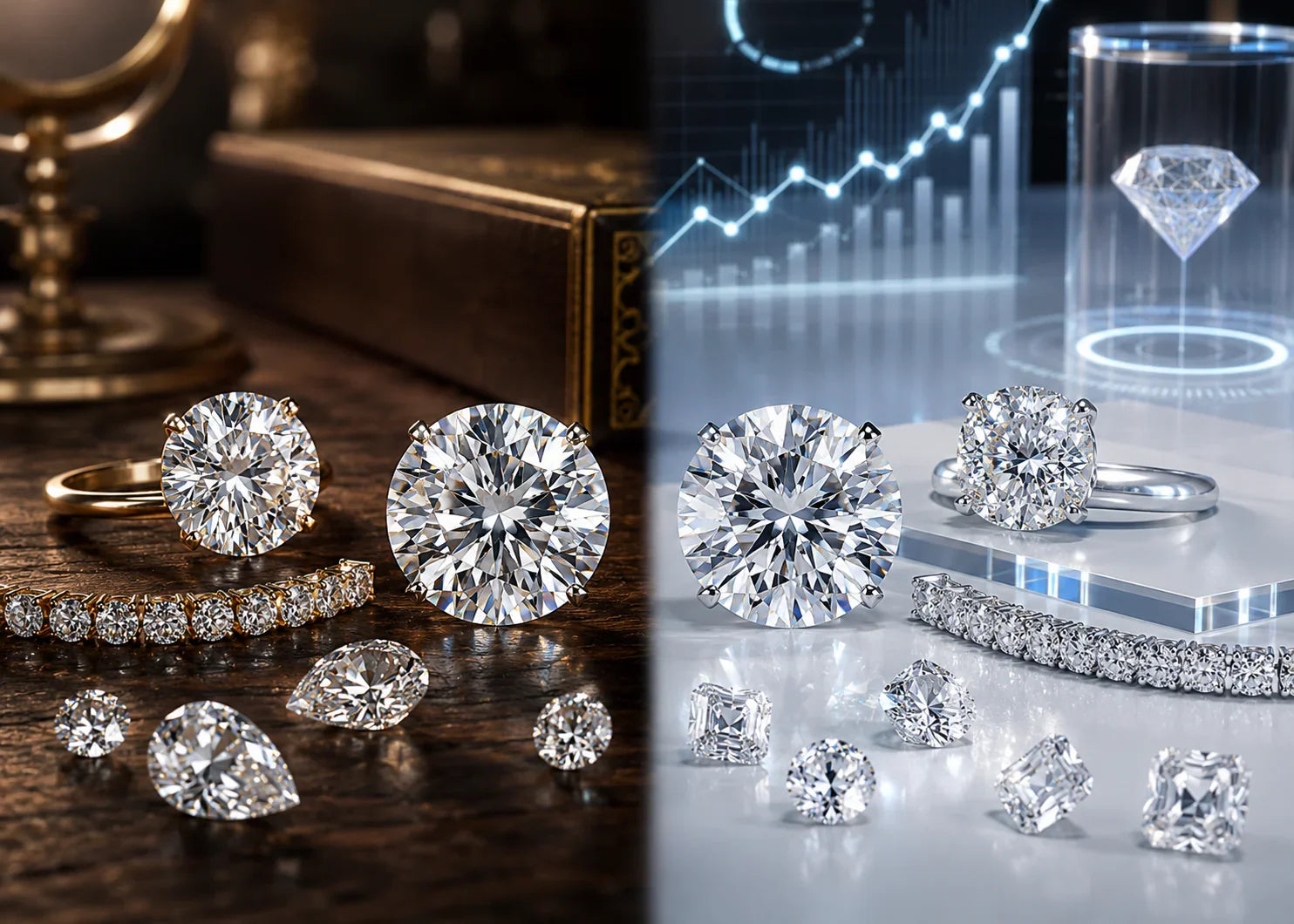
The diamond market in 2026 is marked by major differences between natural diamonds and lab-grown diamonds. While laboratory-grown diamonds keep falling in price, natural diamonds are increasingly being repositioned as an exclusive luxury product.
Recent years have changed the entire diamond industry. More customers now choose larger stones, custom-designed jewellery and higher quality over traditional standard solutions.
At the same time, price awareness has risen markedly.
Lab-grown diamonds keep falling in price
One of the biggest developments in 2026 is the continued price fall of lab-grown diamonds. Several market reports estimate that prices of laboratory-grown diamonds have fallen markedly since 2020.
Reasons include:
- Sharply rising production
- Cheaper production methods
- Fierce competition between producers
- Greater availability worldwide
In practice, this means many customers can now choose larger diamonds with high colour and clarity at a far lower price than before. Read our guide to the G-J colour grades (in Danish), and what VS+ clarity actually covers (in Danish).
For example, diamonds of 2-4 carats have become far more accessible to ordinary consumers.

Natural diamonds are becoming more exclusive
While lab-grown diamonds have become more affordable, the mined diamond industry is trying in 2026 to strengthen the story of natural diamonds' rarity and exclusivity.
Major players are now focusing more on:
- Traceability
- Documented origin
- Rarity
- Collector value
- Hand-selected qualities
At the same time, production of natural diamonds has been reduced in several places to stabilise the market.
Many customers therefore still choose natural diamonds for:
- Engagement rings
- Investment purchases
- Heirlooms
- Exclusive custom designs

Customers are choosing larger diamonds in 2026
A clear trend in 2026 is the demand for larger centre stones.
In the past, 1 carat was often the goal. Today we see far more:
- 2 carat
- 3 carat
- 5 carat+
- Oval cut
- Emerald cut
- Cushion cut
This is largely due to developments in lab-grown diamonds, where larger sizes have become financially realistic for many customers.

The focus is shifting from perfection to character
An interesting development in 2026 is that more customers accept slightly warmer colours and small natural characteristics in natural diamonds.
Previously, the focus was almost exclusively on:
- D-F colour
- IF/VVS clarity
Now many choose instead:
- H-I-J colour
- VS-SI clarity
- Better cut quality
- More visual value for money
Excellent Cut and the absence of BGM (Brown, Green, Milky) in particular are becoming more important among quality-conscious customers. Read what the colour grade actually means visually and in price (in Danish), so you can make an informed decision.
Custom-designed jewellery is growing strongly
2026 also shows a clear trend: more customers want unique jewellery rather than mass-produced designs.
Custom design makes it possible to get:
- Better diamond quality
- A more personal style
- Larger centre stones
- Better value for money
- A choice between natural and lab-grown diamonds
This also matches developments in the luxury market, where individuality has become more important than traditional brands.

What does this mean for diamond buyers?
In 2026, consumers have more options than ever before. But more options also mean more ways to pay too much – which is why it is important to understand what an uncertified diamond is actually worth (in Danish) before you decide.
Lab-grown diamonds are often best suited for:
- Large carat sizes
- Maximum visual size
- Modern design
- Price-conscious buyers
Natural diamonds are often chosen for:
- Heirlooms
- Exclusive investments
- Rare stones
- Long-term value
- Traditional engagement rings
So the most important thing is not necessarily whether the diamond is natural or lab-grown – but the quality of the diamond itself.
Conclusion – the diamond market in 2026
The diamond market in 2026 is more divided than before.
Lab-grown diamonds continue to grow rapidly and give access to larger diamonds at lower prices.
At the same time, natural diamonds are increasingly positioned as exclusive luxury products focused on rarity, origin and long-term value.
For customers, this means far greater freedom of choice – but also a greater need for professional advice on:
- Cut quality
- Fluorescence
- BGM
- Certification – GIA, IGI and HRD explained (in Danish)
- Price per carat
- Visual quality
At Manich Jewelry, jeweller Erik Manich helps customers choose both natural and lab-grown diamonds based on quality, budget and design wishes. Have you received an offer you are unsure about? You can verify your diamond report free online in 30 seconds (in Danish) before you decide.